International Growth, Market Entry, Acquisition Advisory
Ipanovia is an independent international expansion and acquisition advisory firm. We help CEOs, boards, shareholders, investors, and executive teams accelerate growth in new markets through market entry strategy through acquisition strategies, strategic partnerships, joint ventures, and especially external growth.
Our core expertise is in target identification, screening, and qualification. We help companies move from a broad growth ambition to a structured, actionable pipeline of acquisition opportunities. We map markets, build long lists, screen opportunities, qualify the most relevant targets, and prepare initial outreach to target management.
We combine international business development, market research, digital marketing, technology assessment, commercial strategy, and corporate governance expertise. This makes Ipanovia particularly relevant for companies that need to connect an acquisition opportunity to a clear international growth plan.
Planning international expansion or an acquisition? Let’s discuss your growth strategy, priority markets, and target profile.
Our international M&A advisory services
1. Defining the M&A strategy and acquisition thesis
We turn growth ambitions into actionable search criteria:
Revenue, margin, geographic coverage, or capability objectives;
Company size, profitability level, and ownership structure;
Strategic assets sought: customers, technology, brand, licenses, talent, or networks;
Commercial, marketing, technological, and operational synergies;
Financing, governance, management, and integration constraints.
2. International target research and mapping
Ipanovia identifies companies that may fit the acquisition thesis, including companies that are not publicly for sale. Research can combine company databases, local registries, sector ecosystems, professional associations, trade shows, business networks, local partners, specialized media, digital data, and weak signals
.
Deliverables may include a market map, a documented long list, a prioritized short list, a profile for each target, and recommendations on the sequencing of outreach.
3. Target screening and qualification
Screening involves comparing each target against priority criteria and distinguishing companies that are genuinely compatible from those that are merely similar.
Each target can be assessed based on:
Business activity, offering, and value proposition;
Addressable market, growth, and competitive environment;
Customer base, concentration, recurrence, and cross-selling potential;
Geographic presence and ability to access the local market;
Company size, growth momentum, and available financial indicators;
Ownership, management, and likelihood of openness to a discussion;
Technologies, intellectual property, product architecture, and dependencies;
Reputation, brand image, digital presence, and risk signals;
Compatibility with the acquirer’s strategy, culture, and operating model.
4. Company-Market Fit and Product-Market Fit analysis
A target can be profitable while still being poorly suited to the acquirer. Ipanovia therefore assesses two complementary dimensions:
Company-Market Fit: the target’s ability to strengthen a market, country, channel, or competitive position sought by the acquirer.
Product-Market Fit: the alignment between the target’s offering, market needs, customer usage, adoption level, and development potential within the acquirer’s scope.
This analysis identifies acquisitions that deliver genuine acceleration, rather than simply additional revenue.
5. Marketing and commercial compatibility analysis
An international acquisition should create visible and measurable synergies. Ipanovia assesses, among other factors:
Complementarity of offerings and customer segments;
Overlap or complementarity of portfolios;
Cross-selling and upselling potential;
Brand and positioning consistency;
Maturity of sales channels and digital marketing;
Quality of the commercial pipeline and partnerships;
Customer acquisition costs, retention, and recurrence;
The ability of teams to sell together after the transaction.
6. Technology and digital convergence audit
For technology, SaaS, data, martech, IT, and digital services companies, technology compatibility can determine the real value of the deal. Ipanovia conducts an initial strategic convergence audit covering:
Product architecture and interoperability;
APIs, data, security, and critical dependencies;
Technical debt and scalability;
Product roadmap and functional complementarity;
CRM, marketing automation, analytics, and reporting tools;
Digital maturity and user experience quality;
Intellectual property, licenses, and supplier dependencies;
Convergence effort, cost, and timeline.
This preliminary audit does not replace specialized IT or cybersecurity due diligence. It helps prioritize targets and determine which deeper due diligence is required.
7. Digital, reputation, and weak-signal analysis
A target’s reputation can accelerate or destroy value creation. Ipanovia reviews available public signals: organic visibility, website quality, editorial positioning, social media presence, reviews, customer perception, thought leadership, brand consistency, and potential crisis signals.
This analysis identifies intangible assets, reputational risks, and digital growth levers that could be activated after the acquisition.
8. Management outreach and preparation of initial discussions
Where the client wishes, Ipanovia prepares a confidential and contextualized approach to the executives or shareholders of priority targets. The objective is to present a credible industrial, commercial, or strategic rationale, rather than a generic solicitation.
Ipanovia can contribute to preparing messages, qualifying initial discussions, organizing meetings, and deciding whether to pursue, pause, or discontinue a lead.
9. Board support and preparation for the transaction phase
Ipanovia prepares the information needed by the executive committee, shareholders, and board of directors: comparative scorecards, scenarios, risks, synergies, integration assumptions, questions to ask, and prioritization recommendations.
Depending on the scope of the engagement, we work with the client’s financial, legal, tax, employment, IT, and regulatory advisers to streamline the transition from strategic qualification to due diligence and negotiation.
Success story: supporting an international expansion strategy through acquisitions
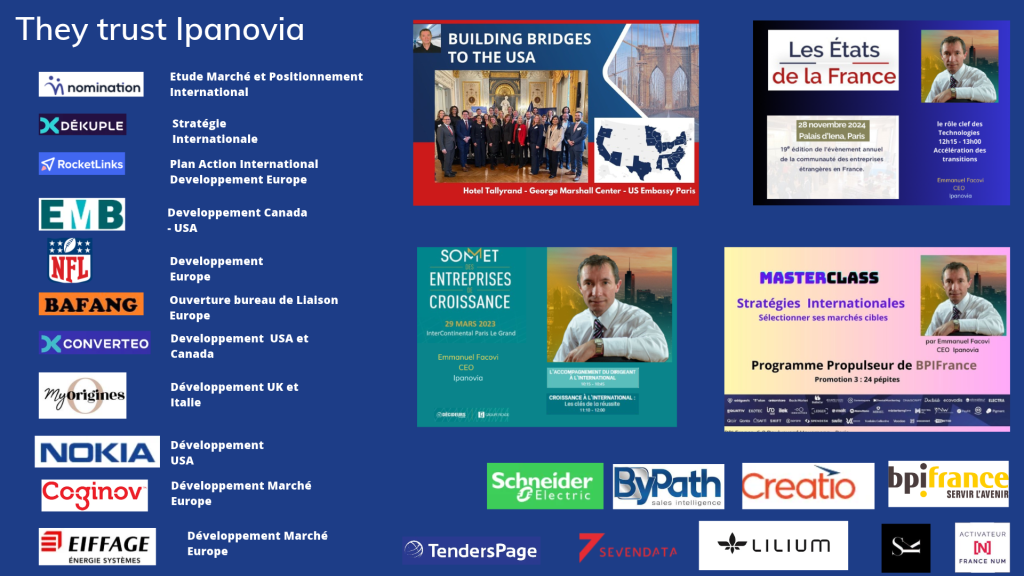
Since 2021, Ipanovia has supported Dékuple, a leading communication and marketing group with revenue of more than €240 million, in its thinking and international development strategy. The approach combined market analysis, opportunity identification, structuring of local presence, and support for growth trajectories.
This work contributed to building an international presence through a series of acquisitions, including in Germany, Spain, the Netherlands, and Poland, while monitoring Italy and the United Kingdom. It also supported the establishment of offices in the United States and Canada and a joint venture in the Middle East, complementing an existing presence in China.
What this success story illustrates: successful international expansion relies on a coherent sequence: country strategy, market selection, target identification, compatibility analysis, local structuring, and progressive integration, with long-term executive support built on a relationship of trust.
Another example is Eiffage, supported in its development strategy for photovoltaics in Italy: Eiffage in Italy.
Your M&A consultant
I am Emmanuel Facovi, Founder of Ipanovia, acting as an adviser to help executives structure their international development strategy: selecting priority countries, choosing presence models (subsidiary, joint venture, local partner, M&A), financing, entity governance, and consolidated reporting.
I bring an experienced external perspective to challenge plans, ask the right questions, and build a coherent international governance framework. I draw on more than 30 years of international leadership and transformation experience across three continents.
FAQ M&A Acquisition target identification, screening, and qualification.
What is international growth strategy? International growth strategy helps companies plan, enter, and scale in new markets. It covers market selection, entry mode choice, partner identification, acquisition strategy, and operational implementation. What is growth through acquisition? Growth through acquisition is a company’s development through acquiring, merging with, or investing in another company. It is often used to accelerate market entry or acquire new capabilities. How does Ipanovia help identify acquisition targets? Ipanovia defines acquisition criteria with clients, builds a long list of potential targets, conducts screening, creates a prioritized short list, and prepares initial outreach to target management teams. What is the difference between market entry and acquisition? Market entry is the broader process of entering a new country or market, which can be done through export, licensing, partnership, joint venture, acquisition, or greenfield investment. Acquisition is one specific route within market entry. What is Company-Market Fit in an acquisition? Company-market fit assesses whether an acquisition target strengthens the market, geography, customer segment, or distribution channel that the acquirer wants to develop. What is Product-Market Fit in an acquisition? Product-market fit assesses whether the target’s product or service meets a real market need, has customer adoption, and can scale within the acquirer’s ecosystem. Does Ipanovia conduct financial or legal due diligence? Ipanovia conducts strategic, commercial, digital, technology, and reputation assessments. Financial, legal, tax, HR, cybersecurity, and regulatory due diligence are conducted with the client’s specialized advisers or recommended partners. What is an international build-up strategy? An international build-up strategy uses a series of complementary acquisitions to build a stronger platform in a market, sector, or geography. It is often used to consolidate fragmented markets or accelerate international expansion. Which markets does Ipanovia cover? Ipanovia supports projects in Europe, North America, the Middle East, and other international markets. Coverage depends on the sector, local partners, language, regulation, and the client’s strategic objectives. How does Ipanovia work with boards and executive teams? Ipanovia provides decision-ready analysis, target scorecards, strategic risk assessments, synergy analysis, integration considerations, and recommendations for boards, executive committees, and investment committees.